
 ON khabar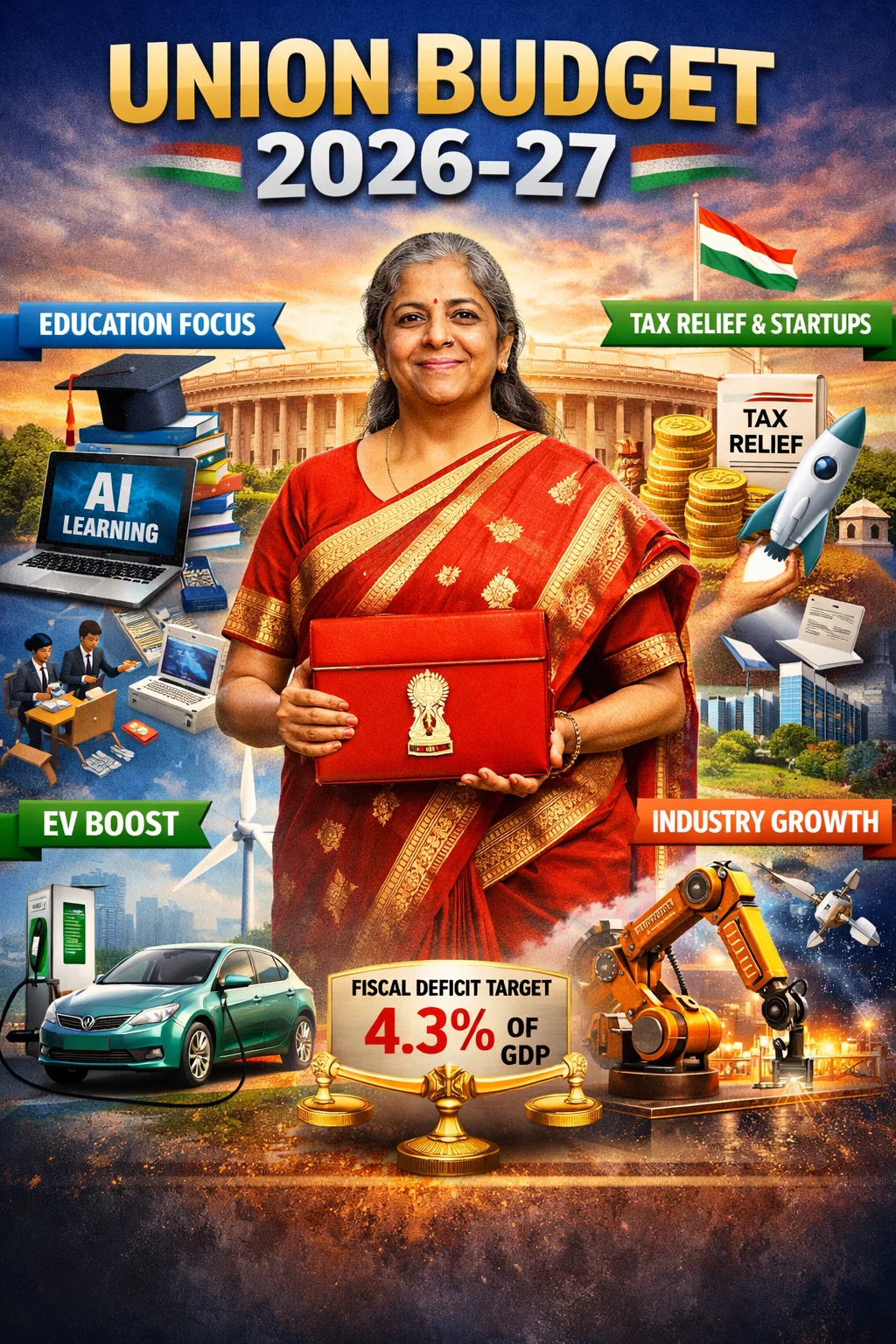
Finance Minister Nirmala Sitharaman is set to present the Union Budget for 2026-27 on February 1, 2026, a historic Sunday presentation. This budget, her ninth in a row, is more than just an annual account statement; it’s a strategic blueprint for India’s next phase of growth as it strides towards the Viksit Bharat 2047 vision. With expectations running high, this blog breaks down the key sectors—education, industry, startups, and automotive—that are likely to be in focus, explaining what’s at stake in simple terms.

Why This Budget Matters
The budget arrives at a crucial time. Global economic dynamics are shifting, and India is being viewed as a pillar of stable, consistent growth. The government is projected to target a fiscal deficit of 4.3% of GDP for FY2026-27, a balancing act between fueling growth and maintaining fiscal discipline. The budget will also mark the operational launch of the new Income Tax Act from April 1, 2026, making clarity and smooth implementation a top priority for businesses and individuals alike.

Section 1: Education – Building the Foundation for a Global Hub
The education sector is vocal about its needs, moving beyond just demanding higher allocations to seeking smart, outcome-oriented investments.
Key Expectations:
Skilling & Digital Infrastructure: There’s a strong call to strengthen digital learning platforms and bridge the digital divide, especially in underdeveloped regions. As Ravin Nair of QS I-GAUGE notes, a strong education budget is critical for India to emerge as a global educational hub.
Funding for NEP 2020: Adequate funding for the National Education Policy 2020 is essential. Experts like Shishir Jaipuria emphasize teacher professional development as a key area that needs investment.
AI in Education: Following last year’s allocation of ₹500 crore for AI Centres of Excellence, increased focus on AI-based learning tools and curriculum integration is expected.
GST Rationalization: A significant pain point is the GST on educational inputs. Industry leaders like Sumeet Mehta of LEAD Group are calling for removing the 18% GST on textbook paper and lowering taxes on digital tools to make quality education more affordable.
In Simple Terms: Think of it as upgrading India’s “learning factory.” The budget is expected to fund better teacher training (skilling the trainers), provide more laptops and internet access (digital infrastructure), and use AI for personalized learning—all while trying to reduce the tax on books and educational apps to make them cheaper.
Section 2: Industry & Startups – Seeking Clarity, Relief, and Growth
The business community is looking for predictability and mechanisms that ease doing business, rather than just sops.
Key Expectations:
Faster Tax Dispute Resolution: An ET-PwC survey found that 44% of CFOs want quicker resolution of tax disputes through mediation. All healthcare and pharma companies surveyed want this improvement. Delays in disputes tie up capital and create uncertainty.
Support for Startups: The flagship 100% income tax exemption under Section 80-IAC for eligible startups is set to end on April 1, 2030. The startup ecosystem is seeking an extension to 2032 or 2035 to continue attracting entrepreneurial talent.
Encouraging Foreign Investment: To bring in global capital, there are calls to rationalize the ~12.5% long-term capital gains tax for foreign investors in high-impact sectors like edtech and deep tech.
Tax Certainty & PLI Expansion: As EY India’s Sameer Gupta highlights, businesses want a “strong commitment to tax certainty.” There is also anticipation that the Production-Linked Incentive (PLI) scheme may be extended to sunrise sectors like AI, space, and robotics.
In Simple Terms: Businesses are saying, “We’re happy to pay taxes, but make the rules clear and help us resolve disagreements faster.” Startups are asking for more time to grow tax-free before they become profitable. The government might also announce cashback schemes (PLI) for companies making advanced products in AI and robotics.
Section 3: Auto Industry – Charging Up the EV Revolution and Mass Market
Contributing 7% to GDP, the automobile sector seeks stability and policies that boost both adoption and manufacturing.
Key Expectations:
Affordability Measures: With only 26 cars per 1,000 people in India (vs. 183 in China), the budget might introduce measures to improve affordability in the mass-market segments, possibly through revised duty structures or incentives.
EV Ecosystem Support: The push for Electric Vehicles (EVs) continues. Industry demands include:
Rationalizing Inverted Duty on EVs: This means ensuring taxes on finished EVs aren’t lower than taxes on their parts, which hurts local manufacturing.
Reducing GST on Charging Services: Lowering the 18% GST on EV charging to 5% to make running an EV cheaper.
Lower Import Duty on Battery Parts: Battery components make up 40-50% of an EV’s cost. Lower import duties could reduce the final price.
In Simple Terms: The car industry wants to put more people behind the wheel by making cars (especially electric ones) cheaper to buy and run. This could mean lower taxes on electric car parts and on the electricity used at public charging stations.
Section 4: The Big Transition – The New Income Tax Act
Come April 2026, the new Income Tax Act is set to replace the decades-old law. This budget will be the final one before its implementation. Companies and individuals are seeking:
Clear Guidelines: Unambiguous rules to ensure a smooth transition.
Strong Dispute Resolution: Mechanisms to handle any teething problems swiftly.
The hope is for a simpler, more transparent tax system that reduces litigation and eases compliance.
Conclusion: A Budget for the Future
Union Budget 2026-27 is poised to be a pivotal document. It’s not just about allocating funds but about strategically investing in human capital (education), providing a stable and encouraging environment for businesses (tax relief, startup support), and driving a sustainable industrial transition (EVs). As Finance Minister Sitharaman rises to present the budget on that Sunday in February, the nation will be watching for a plan that balances immediate economic needs with the long-term ambitions of a Viksit Bharat.
FAQ: Union Budget 2026-27
Q1: When will Union Budget 2026-27 be presented?
A: The budget will be presented by Finance Minister Nirmala Sitharaman on February 1, 2026 (Sunday).
Q2: What is the expected fiscal deficit target for 2026-27?
A: BMI, a Fitch Solutions unit, projects the government will target a fiscal deficit of 4.3% of GDP for FY2026-27.
Q3: What is the main focus of the education sector in this budget?
A: The sector is seeking higher allocation for digital infrastructure, teacher training (NEP 2020), AI-based learning, and GST rationalization on educational inputs like textbooks.
Q4: What are startups expecting from Budget 2026-27?
A: Startups are primarily seeking an extension of the 100% tax exemption under Section 80-IAC beyond its current April 2030 deadline, along with simpler capital gains tax rules for foreign investors.
Q5: What changes does the auto industry want for EVs?
A: Key demands include rationalizing the inverted duty structure on EVs, reducing GST on charging services from 18%, and lowering import duties on critical battery components.
Q6: What is significant about April 1, 2026, in this budget context?
A: The new Income Tax Act is set to come into effect from this date. This budget is expected to provide clarity and ensure a smooth transition to the new regime.
Q7: What is the Viksit Bharat 2047 vision?
A: It is the government’s long-term vision to transform India into a developed nation by the year 2047, the 100th year of its independence. This budget is seen as a stepping stone towards that goal.