
 ON khabar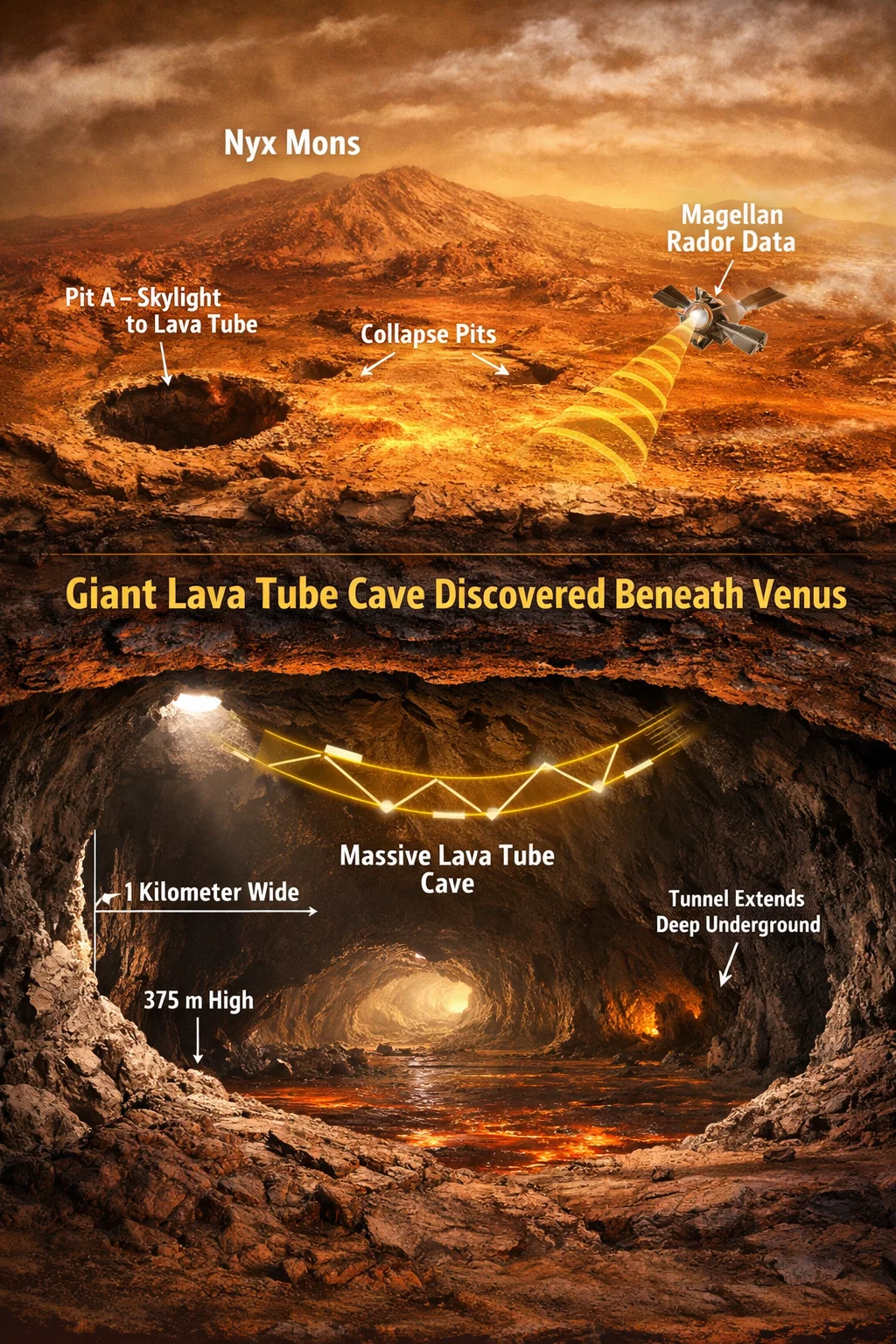
For decades, Venus has been called Earth’s “twisted twin.” It is roughly the same size as our home planet, but while Earth is a blue marble of life and water, Venus is a hellscape of crushing pressure, sulfuric acid clouds, and temperatures hot enough to melt lead.
But today, Venus just got a lot more interesting.
For the first time in history, astronomers have strong evidence that a giant volcanic cave lies beneath the surface of our neighboring world. By digging through 30-year-old data from NASA’s Magellan mission, a team of researchers from the University of Trento has identified what appears to be a massive lava tube hiding under the volcano Nyx Mons.
This discovery, published in the journal Nature Communications, marks the first direct radar evidence of a subsurface tunnel on Venus. Let’s break down what they found, why it looks like a sci-fi movie set, and why this matters for understanding planets.
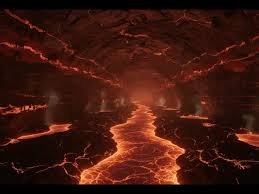
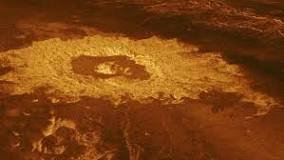
The Hidden Monster: A Cave Beneath Nyx Mons
You might be wondering: How do you find a cave on a planet wrapped in thick, poisonous clouds?
You cannot use a regular camera. Venus’s atmosphere is so dense and cloudy that it is impossible to see the surface with visible light. Instead, scientists rely on radar. Back in the early 1990s, NASA’s Magellan spacecraft used Synthetic Aperture Radar to “see” through the clouds and map the entire surface of Venus.
For thirty years, those images sat in an archive. But recently, the Italian team looked at them with fresh eyes—and a new hypothesis.
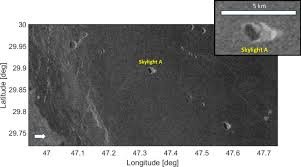
They focused on the western flank of Nyx Mons, a shield volcano that stretches about 362 kilometers wide (roughly the distance from New York to Boston). In the radar images, they noticed a dark pit surrounded by a chain of similar collapses. They named the most promising depression “Pit A.”
Most pits on Venus look like simple holes. But Pit A was different. Its radar echo showed a bright, asymmetric streak stretching far beyond the rim.
According to the team, this pattern is a “smoking gun.” It matches exactly what happens when radar waves enter a skylight (a collapsed cave roof), bounce along an underground tunnel, and scatter back to the spacecraft. In short: Pit A is a doorway to a massive underground cavern.
How Big is This Venusian Cave? (Spoiler: It’s a Monster)
When we think of caves on Earth, we imagine tight crawl spaces or cathedral-like rooms. The famous lava tubes on Earth, like the Cueva de los Verdes in Lanzarote, are only a few tens of meters wide.
The Venus lava tube is in a league of its own.
By measuring the radar brightening and the shadows cast by Pit A, the researchers estimated the size of the hidden void. Get ready for some jaw-dropping numbers:
Width: The tube averages roughly 1 kilometer wide (that’s 0.62 miles).
Height: The empty space below the roof is at least 375 meters high (taller than the Eiffel Tower).
Roof Thickness: The ceiling of rock above the tube is at least 150 meters thick.
Length: Radar echoes show the signal traveling inside the tube for at least 300 meters from the skylight. However, based on the alignment of nearby pits and the slope of the terrain, the full system likely extends for around 45 kilometers beneath Nyx Mons.
Imagine a tunnel wide enough to fit an entire city block, tall enough to stack the Statue of Liberty three times over, and stretching for 28 miles. That is the scale of the volcanic plumbing on Venus.
Why Lava Tubes Matter (Even on a Hellish Planet)
You might be thinking: Okay, it’s a big hole. So what?
Lava tubes are much more than geological curiosities. They are time capsules and potential game-changers for space exploration.
1. A Record of Volcanic History
Lava tubes form when the surface of a lava flow cools and hardens while the molten rock inside continues to drain away. This leaves a hollow tunnel. By studying these tubes, scientists can understand how Venus’s volcanoes erupted, how fast the lava moved, and how the planet cooled over time. They offer a direct window into the planet’s thermal history.
2. A Warning for Earth
Venus is a cautionary tale. It is a rocky world the same size as Earth, but it suffered a runaway greenhouse effect. Its atmosphere is 96% carbon dioxide, with pressures 90 times greater than Earth’s, and surface temperatures exceeding 450°C (850°F) .
Understanding how Venus’s volcanic plumbing moves gas between the planet’s interior and its atmosphere is crucial. Volcanoes release carbon dioxide and sulfur. If Venus had massive, sustained volcanic eruptions in the past, that might explain how it tipped from “habitable” to “hostile.” By studying these tubes, we learn how planets die.
3. Natural Shelters (For Robots, Not Humans… Yet)
On the Moon and Mars, lava tubes are considered prime real estate for future astronauts. The solid rock walls block harmful cosmic radiation and micrometeorites.
However, do not pack your bags for Venus. No human will ever walk inside this cave. The surface pressure on Venus is equivalent to being 900 meters (3,000 feet) deep in the ocean on Earth, and the heat would vaporize you instantly. But robotic probes? Maybe one day, a rover could drop into a skylight to explore a relatively cooler (but still deadly) environment protected from the corrosive clouds.
The Next Generation: New Missions Are Coming
The most exciting part of this discovery is that it was made with old data. If a tube this massive was hiding in plain sight in 30-year-old radar images, how many more are waiting to be found?
Future orbiters are going to blow the doors off this discovery.
NASA’s VERITAS Mission: Set to launch in the early 2030s, VERITAS will carry a next-generation radar that can map Venus with resolutions down to a few tens of meters. It will be able to spot smaller pits and measure surface deformation that might indicate hidden tubes.
ESA’s EnVision Mission: This European spacecraft will carry a Subsurface Radar Sounder. Unlike Magellan, which only saw the surface, EnVision can send radio waves a few hundred meters below the surface. It could potentially map intact lava tubes that have no surface collapse at all.
These missions will give us a 3D picture of Venus’s volcanic systems for the first time.
View this post on Instagram
The Takeaway: We Are Just Scratching the Surface
The confirmation of a giant volcanic cave on Venus is a landmark moment. It proves that underground tunnels exist on our sister planet and that they are enormous compared to anything on Earth.
It also proves that old data never truly dies. The Magellan mission ended in 1994, but its radar echoes are still making history today.
As we look toward the future with VERITAS and EnVision, we are about to enter a golden age of Venus exploration. And we now know that beneath that scorched, poisonous surface lies a hidden world of caverns, waiting to tell us the story of how Earth’s twin went terribly wrong.
Frequently Asked Questions (FAQ)
Q1: Is there really a cave on Venus?
Yes, astronomers now have strong evidence for a giant lava tube beneath the surface of Venus. Using radar data from the Magellan mission, they found a “skylight” (Pit A) on the volcano Nyx Mons that shows radar echoes bouncing off a long, empty tunnel underground.
Q2: How big is the Venus lava tube?
It is enormous. The tube is roughly 1 kilometer wide (0.62 miles) and at least 375 meters high (1,230 feet). The roof is about 150 meters thick. Based on the surrounding terrain, the full system likely extends for about 45 kilometers (28 miles) underground.
Q3: Could a human survive in that cave?
Absolutely not. While the cave roof would block radiation, the temperature inside the crust of Venus is still extremely high (hundreds of degrees Celsius). The atmospheric pressure on Venus is 90 times Earth’s, which would crush a human instantly. This cave is only interesting for robots or for geological study.
Q4: How did they find it if we can’t see through the clouds?
NASA’s Magellan spacecraft used Synthetic Aperture Radar (SAR). Radar waves can penetrate the thick clouds of Venus. When the radar hit the skylight (Pit A), it bounced into the tunnel, traveled along it, and scattered back to the satellite, creating a unique bright streak in the image.
Q5: Why is this discovery important?
It confirms that massive volcanic tunnels exist on Venus. This helps scientists understand how Venus’s volcanoes worked, how the planet lost its oceans, and how a runaway greenhouse effect changed the planet. It also opens the door to finding more caves on other planets.
Q6: When will we see better images of this cave?
Soon. Two missions are planned for the early 2030s: NASA’s VERITAS and the European Space Agency’s EnVision. They will carry much sharper radar instruments that can see beneath the surface and map these tubes in high resolution.
Q7: Does this mean there is life on Venus?
This discovery does not suggest life exists. The conditions on Venus are far too extreme for life as we know it (acid clouds, crushing pressure, 450°C heat). However, the discovery of caves on other planets always excites astrobiologists because caves can sometimes protect organisms from harsh surface conditions—but on Venus, it is still far too hot.