
 ON khabar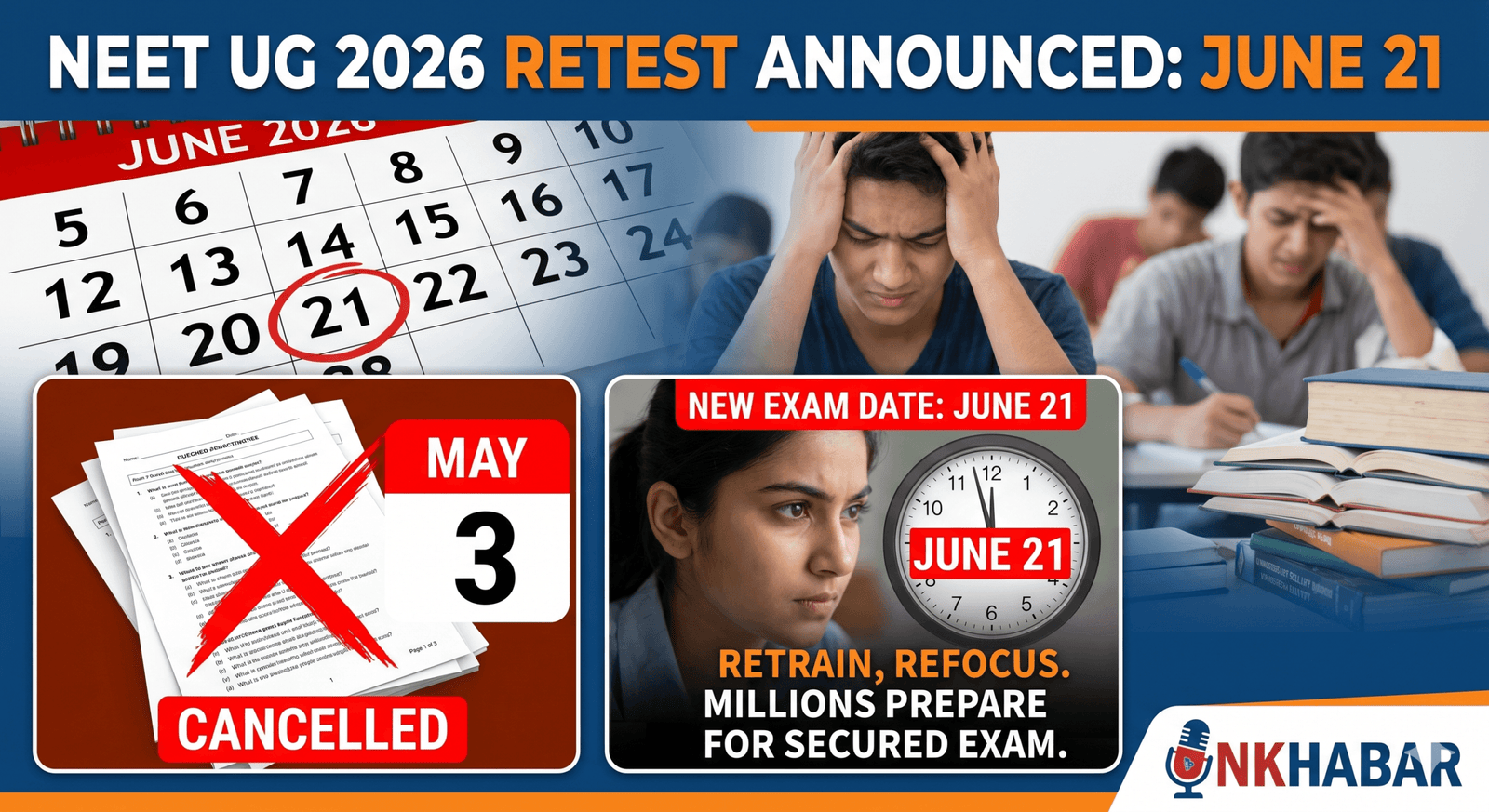
The future of over 22.79 lakh medical aspirants was thrown into uncertainty this week. The National Testing Agency (NTA) made the shocking decision to cancel the NEET UG 2026 examination, which was originally held on May 3, following concrete evidence of a major paper leak.
In a desperate attempt to save the academic year and restore faith in the system, the NTA announced that a NEET UG 2026 retest will be conducted on June 21. This decision has left millions of students and their families in a state of anxiety, confusion, and anger.
Let’s break down exactly what happened, how the leak unfolded, what the government is doing about it, and how you should prepare for the upcoming retest.
The Heartbreak: Why Was the Exam Canceled?
The NTA initially tried to maintain that the exam was conducted smoothly. However, everything changed on the night of May 7—four days after the exam. According to NTA chief Abhishek Singh, a whistleblower came forward with explosive evidence: WhatsApp messages containing questions that were identical to those on the NEET UG 2026 paper.
The agency realized this wasn’t just a small rumor. This was a organized network.
Investigations have since revealed a staggering level of premeditation. A digital document containing roughly 410 questions had been circulating on WhatsApp groups for nearly a month before the exam date. Shockingly, nearly 120 questions from the Chemistry section in that leaked document matched the actual paper word-for-word.
How the Leak Unraveled: A Trail Across India
The paper leak wasn’t the work of one person; it was a well-oiled machine spanning multiple states. Here is the simple breakdown of how the conspiracy spread:
1. The Origin in Maharashtra
The leak reportedly originated in Nashik, Maharashtra. The Central Bureau of Investigation (CBI) detained a 30-year-old ayurvedic medicine student named Shubham Khairnar. He is accused of purchasing the leaked paper from a suspect in Pune for a hefty sum of Rs 10 lakh.
2. The Profit Motive
Khairnar didn’t stop there. He allegedly sold the paper onward to a buyer in Haryana for Rs 15 lakh, making a quick profit of Rs 5 lakh. This shows how the leak was driven by greed, not just cheating.
3. The Digital Spread
Once the PDF reached Haryana, it didn’t stay there. The paper spread like wildfire to major coaching hubs, specifically Rajasthan’s Sikar, as well as parts of Bihar, Jammu & Kashmir, and Kerala.
4. The “Home Office” in Rajasthan
In one of the most shocking twists, early CBI findings cited by the Times of India suggest that a handwritten copy of the question paper was scanned and converted into a PDF in Rajasthan—by the father of an aspiring student. This PDF was then shared with dozens of students at coaching centers.
5. The Price of Cheating
Students who participated in the leak weren’t innocent victims. Investigators found that some aspirants paid between Rs 2 lakh and Rs 5 lakh for access to the leaked material.
Government Response: Damage Control and the CBI Probe
The central government has ordered a comprehensive CBI investigation. They are not just looking for the students who cheated; they are hunting for the “masterminds” who orchestrated the entire network.
NTA chief Abhishek Singh has taken a hard stance. He stated, “We will not allow anyone to play with the future of our children.” To prevent misinformation, the agency has already blocked over 120 Telegram channels that were either spreading fake news or offering leaked papers during the exam.
However, the public is furious. According to the Economic Times, a medical body has already moved the Supreme Court demanding the resignation of the NTA chief, holding him accountable for the security breach.
A Familiar Crisis: Déjà Vu for Medical Aspirants
This is not the first time NEET has been rocked by scandal. The NEET UG 2024 exam also faced severe paper leak allegations, which led to prolonged legal battles and protests. The fact that this has happened two years in a row has shattered the confidence of students.
Education Minister Dharmendra Pradhan is expected to address the media soon to explain how the government plans to overhaul exam security permanently.
What Happens Next? The June 21 Retest
If you are a student who took the May 3 exam, here is the good news: You do not need to register again. The NTA has confirmed that your existing registration is valid.
New Exam Date: June 21, 2026
Refunds: Fees from the canceled exam will be refunded to the original payment source.
Admit Cards: New admit cards will be issued closer to the exam date.
How to Prepare for the NEET UG 2026 Retest (Without Panicking)
It is natural to feel betrayed and angry. You studied for months, only for cheaters to ruin your first attempt. But here is how you can turn this crisis into an opportunity:
1. Take 24 Hours to Reset
Allow yourself to feel the frustration, but then stop. You have 3-4 weeks until June 21. Do not waste them on anger.
2. Focus on “Forgotten” Topics
Since you already prepared for May 3, you are likely at 80-90% readiness. Use the next two weeks to brush up on the topics you usually forget (like certain Organic Chemistry reactions or Physics derivations).
3. Mock Tests Under Strict Timers
The biggest enemy now is anxiety. Take one full-length mock test every alternate day. Simulate the exam environment exactly. This will build your stamina for the retest.
4. Ignore the Noise
Your WhatsApp and Telegram groups will be full of rumors about “new leaks” or “cancelation protests.” Ignore them. The only official source is the NTA website. Do not fall for scams promising you the paper again.
The Bigger Picture: Can the System Be Trusted?
The honest answer is: right now, trust is at an all-time low. For the exam to be secure on June 21, the NTA and CBI will likely implement unprecedented security measures. We might see:
Strict biometric verification (facial recognition, fingerprint scans).
Ban on electronic devices within a 5km radius of centers.
Randomized question papers (different sets for different students in the same room).
While the leak is tragic, the retest is your chance to prove that merit cannot be bought. The cheaters who paid Rs 5 lakh are now terrified because the NTA has their data. You, who studied hard, have nothing to fear.
Conclusion: The Clock is Ticking
The NEET UG 2026 retest on June 21 is a second chance. Yes, it is unfair that you have to study again because of others’ crimes. But winners adapt. Don’t let the paper leak define your story. Let your score on June 21 define it.
Stay focused, stay legal, and stay confident. Good luck!
Frequently Asked Questions (FAQ)
Q1: Is the NEET UG 2026 exam completely canceled?
A: Yes. The exam held on May 3, 2026, has been fully canceled by the NTA due to a proven paper leak. A retest will be held on June 21.
Q2: Do I need to fill out a new application form for the NEET UG 2026 retest?
A: No. The NTA has confirmed that candidates do not need to register again. Your previous application remains valid. You will receive a new admit card shortly.
Q3: Will my exam fee be refunded?
A: Yes. The NTA has stated that the examination fees for the canceled May 3 test will be refunded to the bank account or payment method used during registration.
Q4: Will the June 21 retest be harder than the original exam?
A: The difficulty level will remain the standard NEET UG level based on the NCERT syllabus. The NTA aims to maintain fairness, not punish the students.
Q5: What is the CBI investigating?
A: The CBI is investigating the entire network of the leak—who stole the paper, who printed it, who distributed it via WhatsApp and Telegram, and which coaching centers were involved. They are also trying to identify the students who paid for the leaked paper.
Q6: What happens to students caught with the leaked paper?
A: Those found guilty of paying for or accessing the leaked paper will likely face a permanent ban from future NTA exams and possible criminal charges under the Public Examinations (Prevention of Unfair Means) Act, 2024.
Q7: Where can I get official updates?
A: Only trust the official NTA website (nta.ac.in) and their official social media handles (X – formerly Twitter). Do not trust screenshots or messages on Telegram or WhatsApp groups.