
 ON khabar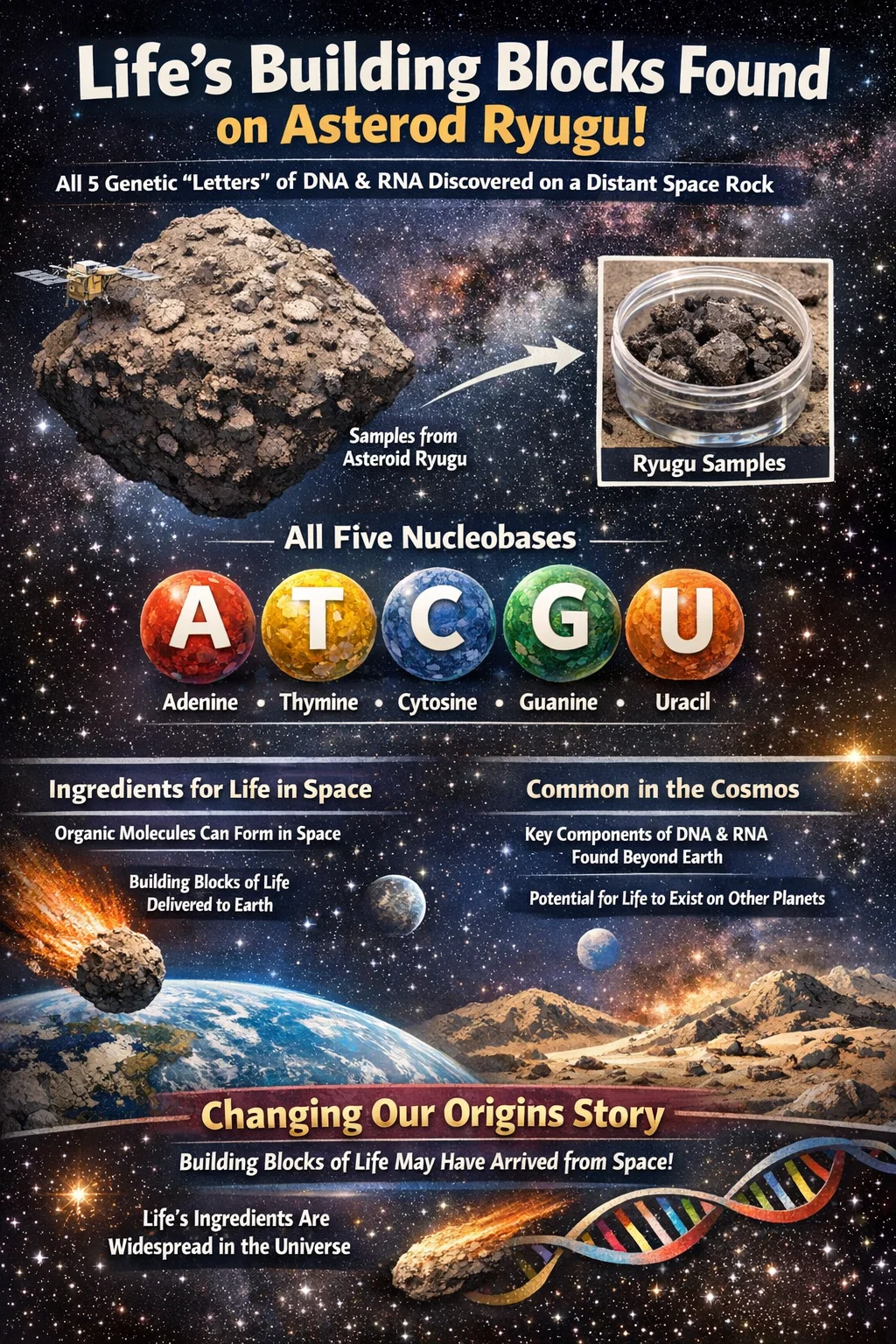
For centuries, humanity has stared up at the stars and asked a simple, profound question: How did we get here?
We know the story of evolution from single cells to complex mammals, but there is a missing chapter at the very beginning. Before the first microbes swam in Earth’s primordial oceans, there had to be a spark. There had to be the right chemical ingredients mixed in the right way.
For a long time, we assumed those ingredients were cooked up right here on Earth in a “primordial soup” fueled by lightning and volcanic heat. But a growing body of evidence—and a very special delivery from a near-Earth asteroid named Ryugu—is turning that story on its head.
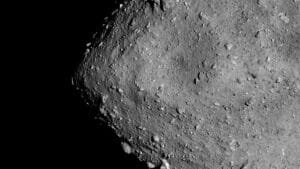
Scientists have just confirmed that Ryugu hosts all five nucleobases, the essential “letters” that spell out the genetic code of DNA and RNA. This isn’t just a cool space rock; it’s a floating library of life’s alphabet. Let’s break down what this means in simple terms and why it’s one of the most exciting discoveries of the decade for astrobiology.
What Exactly Did Scientists Find on Asteroid Ryugu?
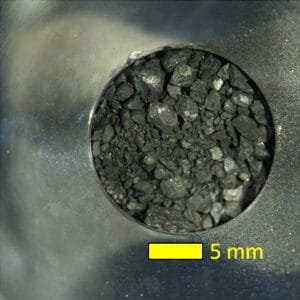
First, let’s talk about the mission. The Japan Aerospace Exploration Agency (JAXA) sent a spacecraft named Hayabusa2 on a six-year, 3.2-billion-mile round trip to grab a pinch of dust from the asteroid Ryugu (pronounced ree-oo-GOO). When that capsule parachuted into the Australian outback in 2020, it carried a treasure trove of ancient, untouched material from the dawn of the solar system.
Researchers, led by biogeochemist Toshiki Koga, have been painstakingly analyzing those grains in hyper-clean labs. Their findings, published in Nature Astronomy, are stunning: The sample contains Adenine (A), Guanine (G), Cytosine (C), Thymine (T), and Uracil (U).
If you remember high school biology:
DNA uses the letters A, G, C, and T.
RNA uses A, G, C, and U.
Finding all five in one place is like finding a complete box of alphabet magnets stuck to an asteroid floating in space. It confirms that the machinery needed to start writing the code of life was not exclusive to Earth—it was being manufactured in deep space billions of years before our planet even finished cooling down.
Why Is This Discovery a “Big Deal”?
We’ve found hints of these molecules before. Scientists have detected amino acids (the building blocks of proteins) and some nucleobases in meteorites that fell to Earth, like the famous Murchison meteorite that landed in Australia in 1969.
However, there was always a shadow of doubt: Contamination.
Did those space rocks have DNA letters on them because they came from space? Or did they get “dirty” the moment they crashed into Earth’s biological-rich soil and atmosphere?
Ryugu solves this mystery in two ways:
Pristine Collection: Hayabusa2 grabbed the sample directly from the asteroid in the vacuum of space and sealed it hermetically. It never touched Earth’s air or dirt until scientists opened it in a sterile clean room.
Equal Abundance: In previous meteorite finds, the mix was uneven. Ryugu showed nearly equal amounts of all five letters. This suggests that the process that created these molecules in the early solar nebula was robust and balanced.
This is the smoking gun evidence astrobiologists have been waiting for. It proves that these molecules are not Earthly hitchhikers; they are genuine extraterrestrial organics.
The Cosmic Kitchen: How Are DNA Letters Made in Space?
You might be picturing a frozen rock floating aimlessly. But the early solar system—the “nebula” that collapsed to form the Sun and planets—was a cosmic chemistry lab.
Here’s the simple explanation of how this works:
The Ingredients: Space is full of simple molecules like water (H₂O), ammonia (NH₃), and methanol (CH₃OH). These are the flour and sugar of our cosmic recipe.
The Freezer Burn: These molecules freeze onto microscopic dust grains in the cold of space, forming interstellar ices.
The Oven: The young Sun sends out ultraviolet radiation and cosmic rays zap these ices. This energy breaks the simple molecules apart and forces them to recombine into more complex structures.
The Result: Over millions of years, these dust grains become coated in nucleobases and amino acids.
Eventually, these dust grains clumped together to form asteroids like Ryugu. This means the ingredients for life were baked into the very clay and rock that built our planet.
“Detecting all five nucleobases in extraterrestrial materials shows that the full set of these key molecules can form in space,” said Koga. “Together with the results from the asteroid Bennu, this strengthens the idea that these molecules may be widespread in primitive asteroid materials.”

The Connection to Earth: Did Asteroids Seed Life?
Now, connect the dots.
4.5 Billion Years Ago: Earth forms. It’s a hellish landscape of molten rock, volcanoes, and constant bombardment by asteroids and comets.
Late Heavy Bombardment: For hundreds of millions of years, Earth gets pummeled by asteroids just like Ryugu.
Delivery Service: Each impact delivers a payload of water, amino acids, and—as we now know—all five nucleobases.
Think of it like this: Earth was a blank, hot hard drive. Asteroids like Ryugu were the pre-loaded software installation discs crashing into it. They didn’t install the finished program (a living cell), but they delivered the source code (A, G, C, T, U) needed to boot up the system.
This theory, known as Panspermia (specifically pseudo-panspermia which refers to the delivery of building blocks, not full life), suggests that the universe is fundamentally “prepped” for biology. Wherever you have a rocky planet in the habitable zone of a star with water, it likely already has these genetic letters waiting in the soil, courtesy of ancient asteroids.
Beyond DNA: The Search for Alien “XNA”
The Ryugu study also revealed something fascinating for the search for alien life. Alongside the standard A, G, C, T, and U, the team found hypoxanthine and xanthine.
These are “cousins” of the standard nucleobases. They aren’t used in Earth’s DNA or RNA, but they are chemically similar. This is incredibly important because if we ever find life on Mars or Europa, it might not use the exact same alphabet we do. It might use XNA—a different kind of genetic molecule.
Finding these “alternative letters” on Ryugu shows that the early solar system was a creative chemist. It wasn’t just making one recipe; it was experimenting with a whole cookbook of potential life molecules. This expands the possible ways life could emerge elsewhere in the cosmos.
How Do We Know It’s Not Just Earth Dirt?
This is the most critical question in this field, and the scientists were ready for it. They employed a method called “blanking.”
They took a piece of the Ryugu sample and analyzed it.
At the same time, in the same lab, they analyzed a sample of pure sea sand and serpentine rock from Earth.
They treated both the space rock and the Earth rock exactly the same.
When they looked at the results, the Earth rocks showed the typical fingerprints of Earthly contamination. The Ryugu sample showed a distinct extraterrestrial signature, particularly in the ratio of carbon isotopes (heavier carbon vs. lighter carbon). Space carbon is different from Earth carbon. The data was clear: Ryugu’s genetic letters were forged in the fires of a distant star or the cold of a nebula, not in a puddle in Japan.
What Does This Mean for You and Me?
On a human level, this discovery is a profound shift in perspective.
For most of history, we saw Earth as a unique oasis separated by a vast, empty, dead void. This new evidence suggests that the void is not empty; it’s fertile.
The gap between “non-living chemistry” and “living biology” is still immense. We haven’t created life in a test tube from these ingredients yet. But this discovery shortens the distance we have to travel to explain our existence. It tells us that Step 1—“Get the Letters”—is easy. The universe does it all the time, everywhere.
As Áine O’Brien, an astrobiologist at the University of Glasgow, put it: “Could meteorites like Murchison have been what brought the ingredients for life to Earth in the first place? That is the point of the entire field of astrobiology.”
We are not just living in the universe. We are made of the universe—specifically, of the dust that drifted between the stars and stuck to asteroids like Ryugu.
Frequently Asked Questions (FAQ)
Q1: Did scientists find actual DNA or life on Ryugu?
A: No. They found the chemical building blocks (nucleobases) that make up DNA and RNA. It’s like finding a pile of bricks, glass, and wood. You haven’t found a house, but you’ve found the essential materials needed to build one. There is no evidence of actual living organisms on Ryugu.
Q2: What is the difference between Ryugu and Bennu?
A: Both are near-Earth asteroids classified as carbonaceous chondrites (primitive, carbon-rich space rocks). Ryugu was sampled by Japan’s Hayabusa2 mission. Bennu was sampled by NASA’s OSIRIS-REx mission. Both missions are finding similar organic molecules, which reinforces the idea that these ingredients are common throughout the solar system.
Q3: How did the nucleobases survive the trip to Earth?
A: When meteorites enter the atmosphere, only the very outer layer burns up (ablation). The interior of the rock can remain as cold as space. Since the Hayabusa2 sample was returned in a sealed capsule with a heat shield and parachute, it never experienced the fiery entry of a normal meteorite.
Q4: If asteroids brought the ingredients, why doesn’t life start everywhere?
A: Having the letters is only step one. You need the right environment—liquid water, a stable climate, and energy sources (like hydrothermal vents or sunlight)—to string those letters together into a meaningful code that can self-replicate. This is called abiogenesis, and it remains the holy grail of origin-of-life research.
Q5: What is the “XNA” mentioned in the article?
A: XNA stands for Xeno Nucleic Acid. It’s a hypothetical type of genetic material that uses different chemical backbones or letters than the DNA/RNA we know. Finding “analogues” (similar but different molecules) on Ryugu suggests that if life evolved elsewhere, it might use a completely different genetic alphabet than Earth life.
Q6: What is the significance of the “equal amounts” finding?
A: In older meteorites like Murchison, scientists found way more Purines (A and G) than Pyrimidines (C, T, U). That made them wonder if the Pyrimidines were just getting destroyed over time or if they were never there. Ryugu having a balanced set suggests the early solar system produced a complete set of letters ready to go.
Q7: Is this proof of aliens?
A: No. It is proof that the chemistry of life is universal. It does not prove there are little green men out there. However, it dramatically increases the statistical probability that microbial life could exist elsewhere, because it shows the starting materials are already on the surface of planets across the galaxy.