
 ON khabar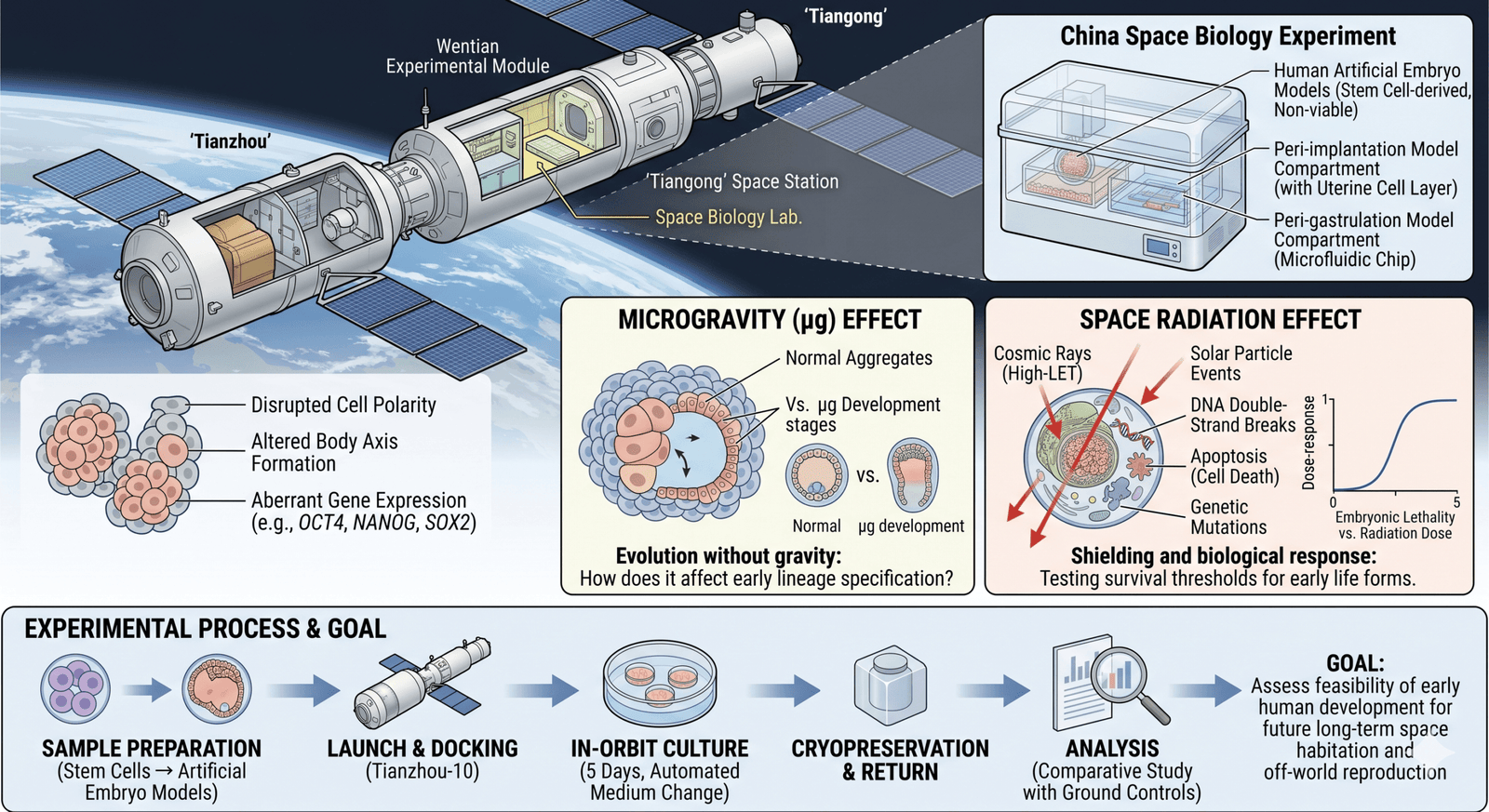
Imagine a future where humans don’t just visit space—they are born there. It sounds like science fiction, but it is quickly becoming a scientific question we must answer.
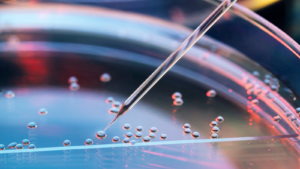
Recently, the Chinese Academy of Sciences announced a groundbreaking and somewhat controversial experiment. They have sent artificial human embryos to the Tiangong space station to see how they develop in the harsh environment of space.
But before your imagination runs wild with space babies and orbital nurseries, let’s break down what this actually means. What are artificial embryos? Why is China doing this? And most importantly, could a human ever successfully develop from conception to birth in zero gravity?
Let’s explore this fascinating topic in simple terms.
Part 1: What Exactly is an “Artificial Human Embryo”?
The term “artificial human embryo” sounds like something out of a sci-fi horror movie, but the reality is less frightening and more scientific.
A natural human embryo is created when a sperm fertilizes an egg. That single cell contains all the instructions needed to build a baby, a child, and eventually an adult.
An artificial human embryo is different. Scientists create it in a lab using stem cells. These cells are coaxed into forming a structure that mimics an early-stage real embryo. However, there is one critical rule: It cannot develop into a living human fetus.
Think of it like a flight simulator for pilots. It looks and acts like a real cockpit, but it will never actually take off. Similarly, these artificial embryos are realistic models used for research. They contain most of the same cell types found in a very early embryo (around 2 to 3 weeks old), but they lack the ability to grow into a baby.
Why Use Artificial Instead of Real Embryos?
The answer is simple: ethics. Growing real human embryos in space would raise enormous moral questions. By using artificial models, Chinese scientists can study how space affects human development without those ethical headaches.
Part 2: The Experiment: From Earth to Orbit
So, what exactly did China send to space?
According to the report, they sent two different types of these cellular complexes:
One type representing two weeks of development.
Another representing three weeks of development.
These samples traveled aboard the Tianzhou-10 cargo carrier on its way to the Tiangong space station.
The Step-by-Step Plan:
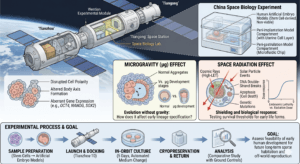
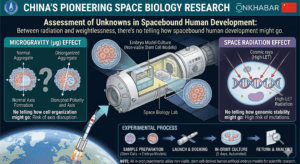
Growth on Earth: Scientists grew the artificial embryos for a short period.
Launch to Space: They were carefully loaded onto the cargo ship and launched into orbit.
Growth in Zero-G: Once aboard the station, the embryos continued growing for five days in microgravity.
Freezing: After five days, the samples were frozen to stop all biological activity.
Analysis: Finally, the frozen samples will be analyzed both on the space station and back on Earth. This allows scientists to compare the space-grown embryos to identical ones grown on the ground.
Professor Yu Leqian, the head of the project at the Chinese Academy of Sciences’ Institute of Zoology, explained the core question: “Life has evolved under gravity for hundreds of millions of years. We want to see if its sudden absence affects development.”
Part 3: Why Does Gravity Matter for Embryos?
For every moment of human history—every birth, every pregnancy, every heartbeat—gravity has been the invisible sculptor of our biology. Our hearts pump upwards against gravity. Our bones grow dense to support our weight. Our fluids flow downwards.
An embryo developing in a womb experiences constant, gentle gravitational pull. It helps cells know which way is “up” and which way is “down.” This “direction” is crucial for organizing the body.
Without gravity: A head might form where feet should be. Cells might not migrate to the right places. The simple act of splitting into two, then four, then eight cells might go haywire.
We simply do not know the answer yet. The results could be:
Minimal impact: Embryos develop fine in space.
Negative impact: Growth is slow, abnormal, or impossible.
Surprising impact: Maybe (just maybe) weightlessness helps growth in ways we don’t expect.
Part 4: It’s Not Just Floating—The Double Threat of Radiation
Weightlessness is only half the problem. The other half is radiation.
Here on Earth, we are protected by a thick atmosphere and a magnetic field that deflects most cosmic rays. In space, that shield is gone. Astronauts on the International Space Station (ISS) or Tiangong are exposed to much higher levels of ionizing radiation.
One recent study reviewed the data and concluded that space is “inherently hostile” to human life. Radiation can tear through DNA, breaking the genetic code that an embryo needs to build a healthy body.
For a microscopic embryo, a single radiation strike to a critical cell could be catastrophic. It could cause mutations, developmental arrest, or cell death.
So the artificial embryos face a double threat:
Microgravity – messing with physical organization.
Radiation – shredding the genetic instruction manual.
Part 5: What This Means for the Future of Humanity
Why should we care about embryos in space? Because if we are serious about becoming a multi-planetary species—living on the Moon, Mars, or in giant space stations—we need to solve the reproduction puzzle.
The Problem of Accidental Pregnancy
NASA has never confirmed sex in space, but with married couples having flown together and more civilians traveling to orbit every year, an accidental pregnancy is almost inevitable. If an astronaut becomes pregnant, would the fetus survive? Would it develop normally? We have no idea.
The Problem of Fertility
Other studies have already shown that microgravity causes problems with:
Sperm motility (sperm don’t swim as well).
Fertilization (egg and sperm struggle to meet without gravity’s help).
If conception itself is hard, and development is risky, then long-term space colonization becomes very difficult.
Potential Solutions (If Space is Hostile)
If the experiment shows that space is harmful, we might need technology to fix it:
Artificial Gravity: A spinning space station (like in the movie 2001: A Space Odyssey) could create centrifugal force that mimics gravity.
Radiation Shielding: Thick walls of water or special materials could protect a pregnant astronaut from cosmic rays.
Low-Speed Centrifuges: A small, constantly spinning “nursery pod” might allow an embryo to develop normally.
Part 6: Ethical Questions and Simple Answers
This research raises eyebrows. Here are the common worries, explained simply.
Q: Is China trying to create the first “space baby”?
A: No. They are using artificial embryos that cannot grow into a real baby. This is basic research, not a reproduction attempt.
Q: Is this dangerous?
A: For humans on Earth, no. The experiment happens entirely in orbit. For the artificial cells, yes—they will be exposed to harsh conditions. But they are not sentient.
Q: Should we be doing this at all?
A: That’s the big question. Some argue we should solve Earth problems first. Others say that if we want to survive long-term (like escaping a future Earth disaster), we must learn how life works in space.
Conclusion: A Small Step for Cells, A Giant Leap for Spacekind
China’s experiment with artificial human embryos in space is a milestone. It is the first time we have seriously asked: Can the next generation of humans be born among the stars?
The results aren’t public yet—the experiment may have already happened or is happening now. When the data comes back, it will shape the future of space travel. If the artificial embryos develop normally, it opens the door to optimism. If they fail, we will know we need artificial gravity and heavy shielding before we even think about space pregnancies.
For now, we wait. One thing is certain: Human life evolved on Earth. Whether it can evolve off Earth is the next great adventure in science.
Frequently Asked Questions (FAQ)
1. Are these “artificial human embryos” actual human babies?
No, absolutely not. They are clusters of stem cells that mimic the structure of an early embryo but lack the ability to grow into a fetus or a baby. They are models, not real embryos.
2. Why is China doing this experiment?
The goal is to see if the lack of gravity affects early human development. Since all life on Earth evolved under gravity, scientists want to know if our cells need gravity to organize themselves correctly.
3. Could a real human baby be born in space right now?
Almost certainly not. Current science suggests that space’s radiation and microgravity are “inherently hostile” to human development. We lack the technology and knowledge to safely grow a human fetus in orbit.
4. What is worse for an embryo: radiation or weightlessness?
Both are serious threats. Radiation can directly damage DNA (the genetic code). Weightlessness can confuse cells about which direction to grow. The combination of both is likely the most dangerous.
5. Has anyone ever been pregnant in space?
No. NASA and other space agencies have strict health rules, and no confirmed pregnancies have occurred in space. However, married couples have flown together, leading to public curiosity about the possibility.
6. When will we know the results of the Chinese experiment?
The Chinese Academy of Sciences has not given a specific timeline. They are growing the embryos for five days, freezing them, then analyzing them. Results could be published in scientific journals within months to a year.
7. If space is bad for embryos, can we fix it?
Yes. Scientists believe that artificial gravity (using a spinning spacecraft) and thick radiation shielding could potentially allow normal development. However, building such a spacecraft is still a future technology.
8. Is this experiment legal?
Yes. China has its own ethical guidelines for stem cell and embryo research. Because these are artificial models that cannot become a fetus, they do not violate international laws against human embryo experimentation.