
 ON khabar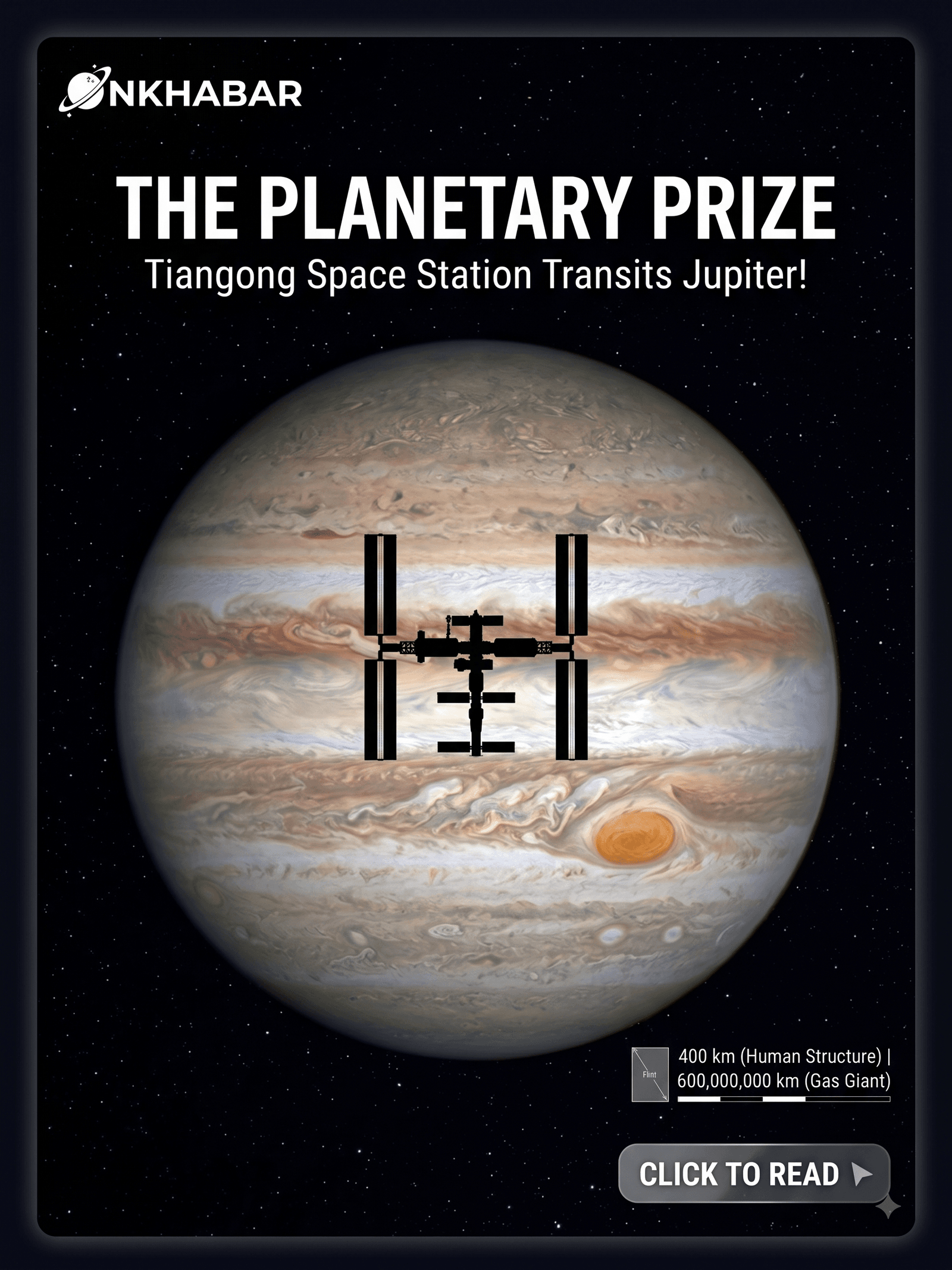
Space stations are not just scientific laboratories. They are also moving targets for photographers on Earth. The International Space Station (ISS) has been in orbit for 27 years, and during that time, astrophotographers have captured it passing in front of the Moon, the Sun, Jupiter, Saturn, and many other bright objects. Now, China’s Tiangong space station is joining the show. A recent photo by Chinese astrophotographer Shen Laosi 347 shows Tiangong flying past Jupiter, and it has amazed space fans around the world.
This type of photography is called space station transit photography. It combines careful planning, precise timing, and a little bit of luck. In this blog post, you will learn what a space station transit is, why these photos are so special, how photographers capture them, and how you can try it yourself.
🟤 The ISS has been in orbit for 27 years now. Over that time, astrophotographers have captured many images of it—against the backdrop of the Moon, the Sun, Jupiter, Saturn, and more. Recently, attention has also begun to turn toward China’s relatively new station, Tiangong.… pic.twitter.com/ybbXoLdK1F
— Black Hole (@konstructivizm) August 15, 2026
What Is a Space Station Transit?
A space station transit happens when a space station passes directly between an observer on Earth and a bright object in the sky, such as the Moon, the Sun, or a planet. When this happens, the station appears as a small, dark silhouette moving quickly across the bright disk of the object.
Think of it like a tiny eclipse. The space station blocks a tiny part of the light for a fraction of a second. Because the station is moving so fast, the entire transit often lasts less than one second. That is why capturing a space station transit is a real challenge.
The ISS and Tiangong both orbit Earth at around 7.6 to 7.7 kilometers per second. That means they cross the face of the Moon or Sun in less than a second in most cases. If you blink, you miss it.
The Growing Popularity of Space Station Photography
For years, the ISS was the main target for transit photographers. It is large, bright, and easy to track. Many astrophotographers have captured stunning images of the ISS crossing the Sun with sunspots visible, or passing in front of a full Moon.
Recently, attention has also turned to Tiangong, China’s relatively new space station. Tiangong is smaller than the ISS, but it is still visible from Earth under the right conditions. It can be photographed with the same techniques used for the ISS.
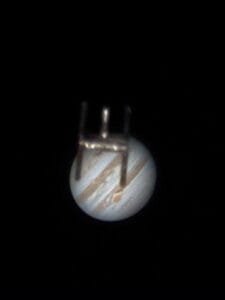
The photo by Shen Laosi 347 is a great example. It shows Tiangong passing in front of Jupiter. Jupiter is the largest planet in our solar system, but from Earth it still looks small. Capturing a space station crossing such a small planetary disk is extremely difficult. It requires perfect alignment, excellent timing, and high-quality equipment.
Why Shen Laosi 347’s Jupiter Transit Photo Stands Out
Shen Laosi 347 is a Chinese astrophotographer known for capturing detailed images of objects in space. In the photo of Tiangong flying past Jupiter, you can see the station as a tiny dark shape against the bright bands of Jupiter’s clouds.
What makes this image so impressive is the precision involved. Jupiter is not as large in the sky as the Moon or the Sun. A transit across Jupiter happens very quickly and only in a very narrow path on Earth. The photographer had to be in exactly the right place at exactly the right time.
The image also shows that Tiangong has become a real target for advanced astrophotography. As the station grows with new modules, it will become even more interesting to photograph.
How Astrophotographers Capture Space Station Transits
Capturing a space station transit is not like taking a normal photo. You cannot simply point a camera at the sky and hope for the best. Here are the main steps and tools involved.
1. Knowing When and Where to Look
The first step is to find out when a space station will pass in front of the Moon, Sun, or a planet. This is done using special prediction tools and websites. Some popular tools include:
Transit-Finder.com – Helps predict ISS and Tiangong transits of the Sun and Moon.
Heavens-Above.com – Shows passes of satellites and space stations.
Calsky – Provides detailed transit predictions for many objects.
These tools calculate the exact path of the station across the sky and show where on Earth the transit will be visible. For a transit to happen, the observer must be within a narrow ground track. For Moon or Sun transits, this path may be only a few kilometers wide. For planet transits like Jupiter, it is even narrower.
2. Equipment Needed
You do not need a spaceship, but you do need some basic astronomy gear. The most common setup includes:
Telescope – A telescope with a focal length of 500 mm to 2000 mm works well.
Camera – A high-speed planetary camera or DSLR/mirrorless camera that can record video.
Mount – A sturdy tripod or tracking mount to keep the telescope steady.
Solar Filter – If you are photographing the Sun, you must use a certified solar filter to protect your eyes and equipment.
GPS or Accurate Clock – Timing is critical, so photographers sync their clocks to exact time.
3. Recording the Transit
Because the station moves so fast, photographers do not take a single long exposure. Instead, they record a video at a high frame rate, such as 30, 60, or even 100 frames per second. Later, they extract the individual frames. One of those frames will show the station in front of the target.
This technique is often called lucky imaging. The photographer records many frames and picks the sharpest one. Sometimes they stack multiple frames to improve detail, but for a transit, the station moves too fast for stacking.
4. Processing the Image
After capturing the video, the photographer processes the frames. They may adjust brightness, contrast, and sharpness. The goal is to show the station clearly against the bright background. The final image is often a single frame or a small combination of frames that shows the station in perfect silhouette.
Challenges of Space Station Transit Photography
Even with the right tools, this kind of photography is very difficult. Here are some of the main challenges.
Extreme Speed
The ISS and Tiangong travel at roughly 7.7 kilometers per second. That is about 17,500 miles per hour. When they cross the Moon or Sun, the transit lasts only about 0.5 to 2 seconds. For a planet like Jupiter, the transit can last just a fraction of a second.
Very Narrow Viewing Path
The ground track for a transit is very narrow. If you are a few hundred meters outside the predicted path, you may miss the transit completely. Many photographers travel long distances to get into the right position.
Weather and Seeing
Clouds, haze, and atmospheric turbulence can ruin a transit photo. Even a thin cloud can block the view. Photographers often check weather forecasts carefully and have backup plans.
Perfect Timing
A clock error of even one second can cause you to miss the shot. Photographers use GPS time or internet time servers to make sure their cameras are synchronized.
Different Targets: Moon, Sun, and Planets
The Moon
The Moon is the easiest target for space station transit photography. It is large, bright, and does not require a solar filter. Many photographers start with Moon transits because they are more common and easier to capture.
The Sun
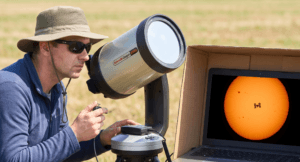
The Sun is also a popular target, but it requires a certified solar filter. Without a proper filter, pointing a telescope at the Sun can cause serious eye damage and destroy your camera. Solar transits are exciting because you can see sunspots and solar granulation in the background.
Jupiter and Other Planets
Planet transits are the hardest. Jupiter is the largest planet and therefore the most common planet target. Saturn, Venus, and Mars are also possible, but they are smaller and harder to capture. A planet transit requires very high magnification and perfect alignment.
Shen Laosi 347’s photo of Tiangong crossing Jupiter is a great example of this advanced level of astrophotography.
How You Can Try Space Station Transit Photography
If you want to try this yourself, here are some simple steps to get started.
Learn the sky. Start by watching the ISS or Tiangong pass overhead at night. You can see them with your naked eye.
Use transit prediction tools. Check websites like Transit-Finder.com to see if a transit will happen near your location.
Start with the Moon. Moon transits are easier than Sun or planet transits. You do not need a solar filter.
Use a high frame rate video. Set your camera to record video, not single photos. This increases your chances of catching the station.
Practice timing. Use an accurate clock and record a few seconds before and after the predicted time.
Stay safe. Never look at the Sun through a telescope without a proper solar filter.
Even if you do not capture a perfect photo on your first try, the process is fun and teaches you a lot about orbital mechanics and astronomy.
Frequently Asked Questions (FAQ)
What is a space station transit?
A space station transit is when the ISS, Tiangong, or another satellite passes directly in front of the Moon, Sun, or a planet as seen from Earth. It looks like a tiny dark silhouette moving quickly across the bright object.
How fast do the ISS and Tiangong travel?
Both the ISS and Tiangong travel at about 7.6 to 7.7 kilometers per second. That is roughly 17,500 miles per hour. Because of this speed, transits last only a fraction of a second.
Can I see Tiangong with my naked eye?
Yes, Tiangong is visible to the naked eye under the right conditions. It looks like a bright point of light moving across the sky. It is not as bright as the ISS, but it can still be seen from many locations.
What equipment do I need to photograph a space station transit?
You need a telescope or long telephoto lens, a camera that can record high-speed video, a sturdy mount, and an accurate clock. For solar transits, you also need a certified solar filter.
How do photographers know exactly when a transit will happen?
They use online prediction tools like Transit-Finder.com and Heavens-Above.com. These tools calculate the exact time and location of a transit based on the station’s orbit and the observer’s position.
Is it safe to photograph the Sun during a transit?
Only if you use a certified solar filter. Never look at the Sun through a telescope or camera without proper protection. The intense sunlight can cause permanent eye damage and destroy your equipment.
Can I use a smartphone to photograph a space station transit?
It is very difficult because smartphones lack the magnification and speed needed. However, you can try holding a smartphone up to a telescope eyepiece. The results are rarely sharp, but it can be a fun experiment.
Why are planet transits like Jupiter so rare?
Planets appear much smaller than the Moon or Sun in the sky. This means the transit path on Earth is extremely narrow, and the station crosses the planet’s disk in a tiny fraction of a second. Perfect alignment and timing are essential.
Who is Shen Laosi 347?
Shen Laosi 347 is a Chinese astrophotographer known for capturing detailed images of objects in space. The photo of Tiangong flying past Jupiter is one of the notable examples of space station transit photography.
Are these transit photos real or composite?
Most transit photos are real single frames extracted from high-speed video. They are not composites, although photographers may adjust brightness and contrast. The station really was in front of the Moon, Sun, or planet at that exact moment.
Conclusion
Space station transit photography is one of the most exciting and challenging forms of astrophotography. It combines science, planning, and art. For 27 years, the ISS has been the star of this niche hobby. Now, China’s Tiangong station is giving photographers a new target.
The image by Shen Laosi 347 of Tiangong passing Jupiter shows just how far this field has come. It proves that even a small station in low Earth orbit can be captured against the giant planet Jupiter with the right skills and tools.
Whether you are a seasoned astrophotographer or a curious beginner, space station transit photography offers a unique way to connect with the wonders of space. So grab a telescope, check a transit prediction, and see if you can catch a space station crossing the sky.